Artificial Intelligence has already transformed how businesses create content, analyze data, and automate repetitive tasks. However, a new evolution is beginning to reshape the software industryâAI Agents.
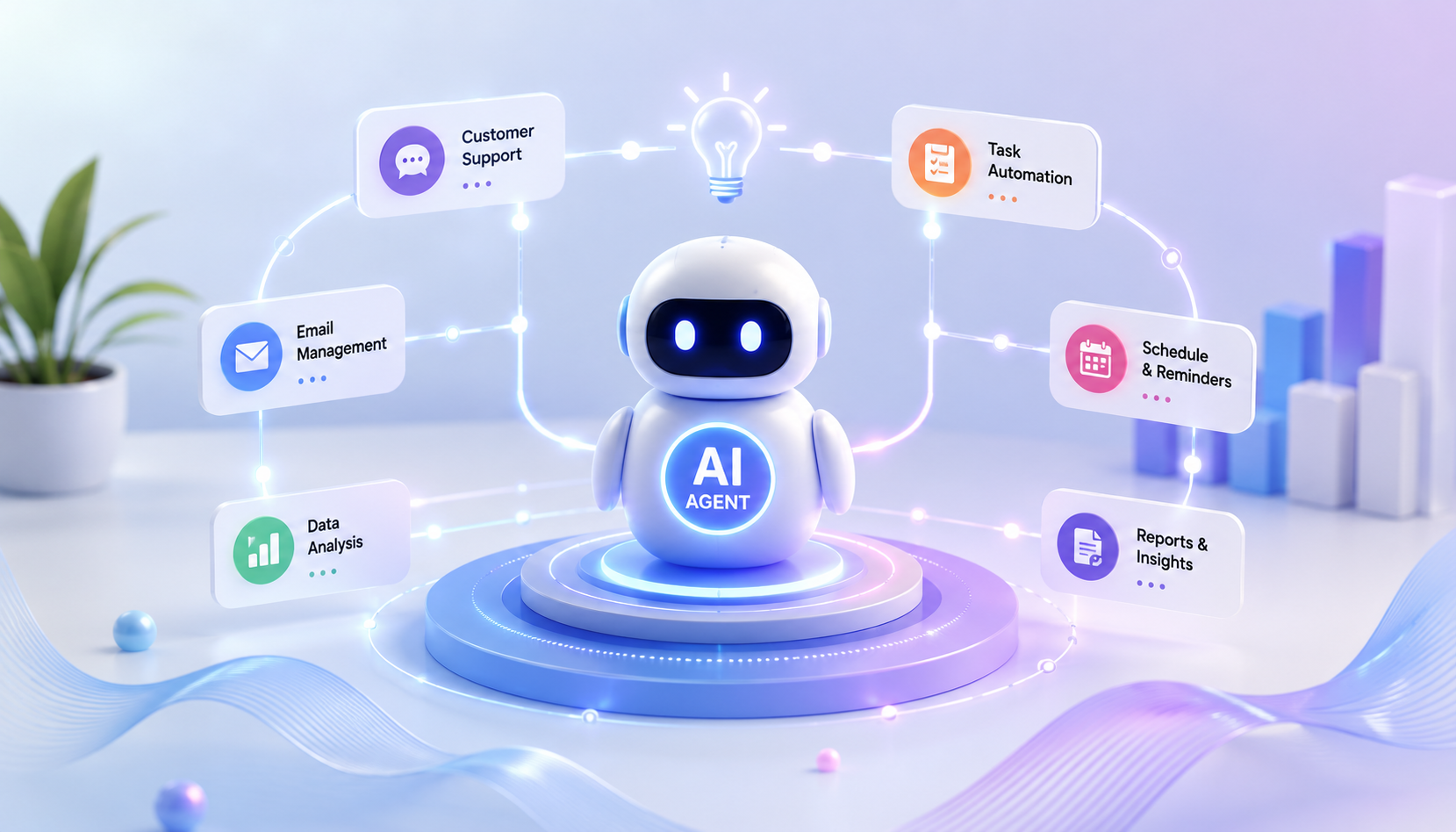
Unlike traditional AI tools that simply respond to prompts, AI Agents can plan, reason, make decisions, and execute multi-step tasks with minimal human involvement. From customer support and software development to project management and business automation, AI Agents are becoming an essential part of modern digital products.
What Is an AI Agent?
An AI Agent is an intelligent software system capable of understanding goals, planning actions, interacting with different tools or APIs, and completing tasks autonomously.
Instead of asking AI one question at a time, you provide a goal such as:
"Build a landing page, optimize the images, publish it, and send me the deployment report."
The AI Agent breaks the objective into multiple tasks and executes them in sequence.
This shift changes AI from an assistant into a digital teammate.
Why Businesses Are Adopting AI Agents
Companies are under constant pressure to reduce operational costs while improving productivity.
AI Agents help by:
- Automating repetitive business workflows
- Reducing manual data entry
- Managing customer support requests
- Scheduling tasks intelligently
- Monitoring systems continuously
- Generating reports automatically
- Assisting software development teams
Rather than replacing employees, AI Agents allow teams to focus on strategic work while routine processes run automatically.
Real-World Applications
AI Agents are already powering a wide range of industries.
Software Development
Developers use AI Agents to:
- Generate code
- Fix bugs
- Review pull requests
- Write documentation
- Deploy applications
- Monitor production systems
Customer Support
Support Agents can:
- Answer customer questions
- Resolve common issues
- Escalate complex tickets
- Personalize responses
- Work 24/7 without downtime
Business Operations
Businesses automate:
- Invoice processing
- CRM updates
- Email management
- Report generation
- Sales follow-ups
- Inventory tracking
These automations significantly reduce operational overhead.
AI Agents and SaaS
Modern SaaS platforms are increasingly embedding AI Agents directly into their products.
Instead of adding another dashboard or feature, companies now provide users with an intelligent assistant capable of completing tasks on their behalf.
This improves user experience while increasing customer retention and product value.
Challenges to Consider
Although AI Agents are powerful, they require thoughtful implementation.
Organizations should focus on:
- Secure API integrations
- Permission-based actions
- Human approval for sensitive tasks
- Comprehensive logging and auditing
- Data privacy compliance
- Performance monitoring
Responsible implementation ensures reliability while maintaining user trust.
The Future
Over the next few years, AI Agents are expected to become a standard feature across websites, mobile apps, enterprise software, and cloud platforms.
Businesses that invest early will gain a competitive advantage through faster operations, smarter decision-making, and more personalized customer experiences.
The next generation of software won't simply provide toolsâit will actively collaborate with users to achieve meaningful outcomes.
Final Thoughts
AI Agents represent one of the most significant shifts in software development since the rise of cloud computing. As organizations continue embracing intelligent automation, products will become more proactive, adaptive, and efficient.
For developers, entrepreneurs, and technology leaders, understanding AI Agents today means being prepared for the software ecosystem of tomorrow.
Share this article
Copy the article link and send it to anyone who may find it useful.