Artificial Intelligence has traditionally relied on cloud computing. Whenever users interacted with an AI application, data was sent to remote servers, processed, and returned within seconds. While this model has enabled remarkable innovation, it also introduces latency, bandwidth costs, and privacy concerns.
In 2026, a new trend is rapidly gaining momentum: Edge AI.
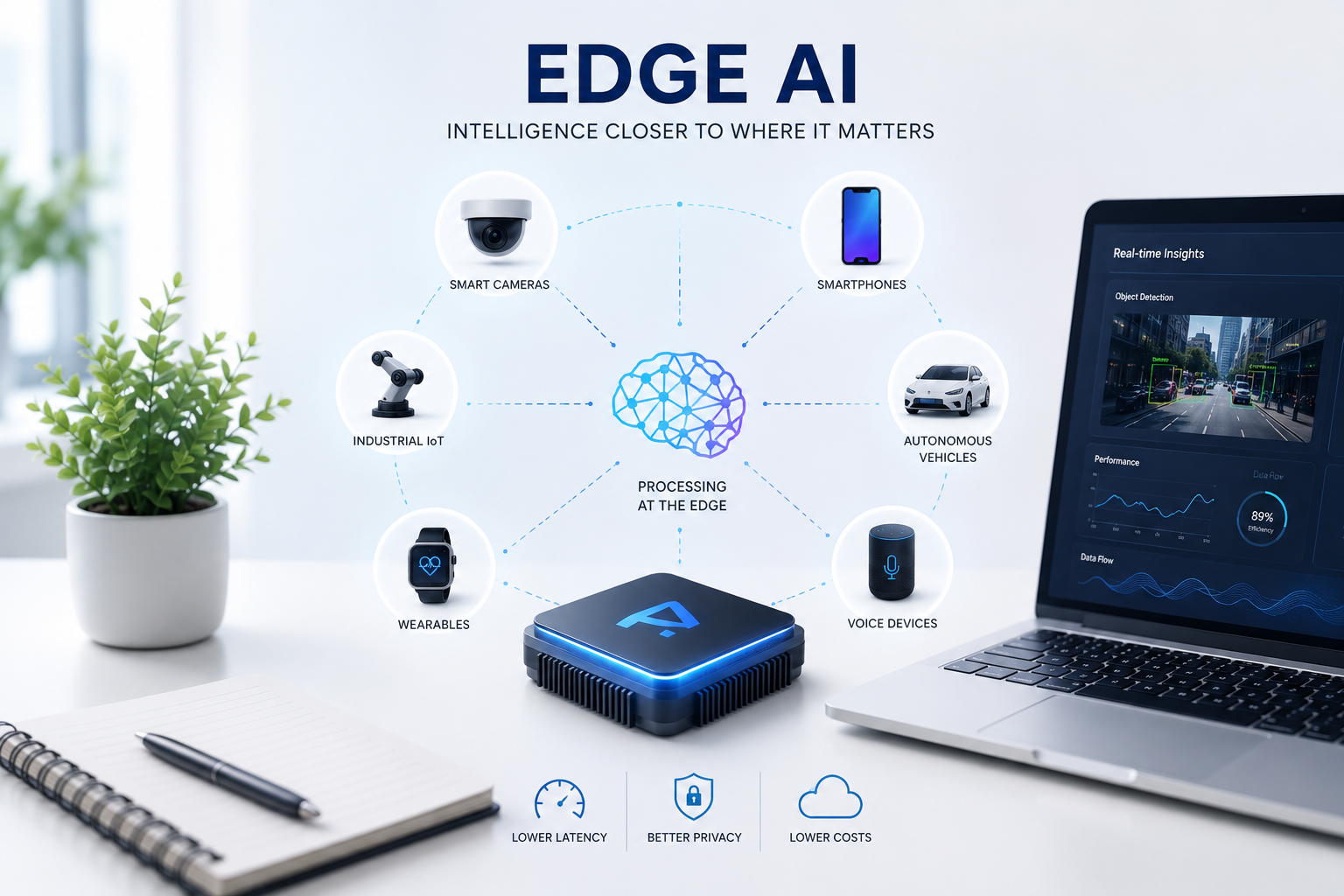
Instead of sending every request to the cloud, Edge AI allows intelligent processing directly on smartphones, laptops, cameras, IoT devices, industrial machines, and even vehicles. This approach is transforming how businesses build faster, more secure, and highly responsive digital products.
What Is Edge AI?
Edge AI refers to running artificial intelligence models locally on hardware devices instead of relying entirely on cloud servers.
Rather than uploading data for processing, the device itself performs the AI inference.
Examples include:
- Smart security cameras detecting movement instantly
- Smartphones editing photos with AI
- Voice assistants responding without internet access
- Manufacturing equipment predicting failures in real time
- Autonomous drones making navigation decisions locally
This significantly reduces delays while improving reliability.
Why Businesses Are Adopting Edge AI
Organizations are increasingly choosing Edge AI because it offers several practical advantages.
Faster Performance
Since processing happens directly on the device, there is almost no network delay.
This is especially valuable for applications that require immediate responses, such as robotics, healthcare devices, and autonomous vehicles.
Improved Privacy
Sensitive information stays on the device instead of constantly being transmitted to cloud servers.
This helps businesses comply with privacy regulations while giving users greater confidence in how their data is handled.
Lower Cloud Costs
Continuous cloud processing can become expensive at scale.
By performing AI tasks locally, companies reduce bandwidth usage and lower infrastructure costs.
Better Offline Experience
Many Edge AI applications continue working even without a stable internet connection.
This is essential for field operations, remote locations, and mobile environments.
Real-World Applications
Edge AI is already powering innovations across multiple industries.
Some common use cases include:
- Facial recognition for secure authentication
- Real-time language translation
- Smart home automation
- Predictive maintenance in factories
- Medical diagnostic devices
- Retail inventory monitoring
- AI-powered drones
- Driver assistance systems
- Industrial quality inspection
- Intelligent surveillance
These applications demand speed and reliability that cloud-only solutions cannot always provide.
What Developers Need to Learn
As Edge AI adoption grows, developers should expand their skills beyond traditional web applications.
Key areas include:
- AI model optimization
- Edge deployment frameworks
- IoT integration
- Efficient hardware utilization
- Real-time data processing
- Secure on-device storage
- Lightweight machine learning models
Building software for resource-constrained devices requires a different mindset than developing cloud-based applications.
Challenges to Consider
Although Edge AI offers significant benefits, developers should also prepare for its limitations.
Challenges include:
- Limited device memory
- Lower processing power compared to cloud GPUs
- Battery consumption
- Model optimization complexity
- Device compatibility
- Security updates across distributed hardware
Careful planning is essential to balance performance and efficiency.
The Future of Intelligent Applications
The future of AI is not cloud versus edgeâit is cloud and edge working together.
Complex model training will continue happening in the cloud, while real-time inference increasingly moves closer to users.
This hybrid approach combines the scalability of cloud computing with the speed and privacy of local processing.
Businesses that adopt this architecture early will build smarter, faster, and more reliable digital experiences.
Final Thoughts
Edge AI represents the next major milestone in artificial intelligence.
As devices become more powerful and AI models become more efficient, intelligent processing will happen wherever users need itânot just inside massive cloud data centers.
For developers, startups, and technology leaders, understanding Edge AI today means being prepared for the next generation of software innovation.
Share this article
Copy the article link and send it to anyone who may find it useful.