Artificial Intelligence has evolved at an incredible pace over the last few years. We first experienced AI through chatbots that could answer questions, generate content, and assist with coding. While these tools dramatically improved productivity, they still relied on one important thing human instructions for every task.
Today, a new generation of AI is emerging.
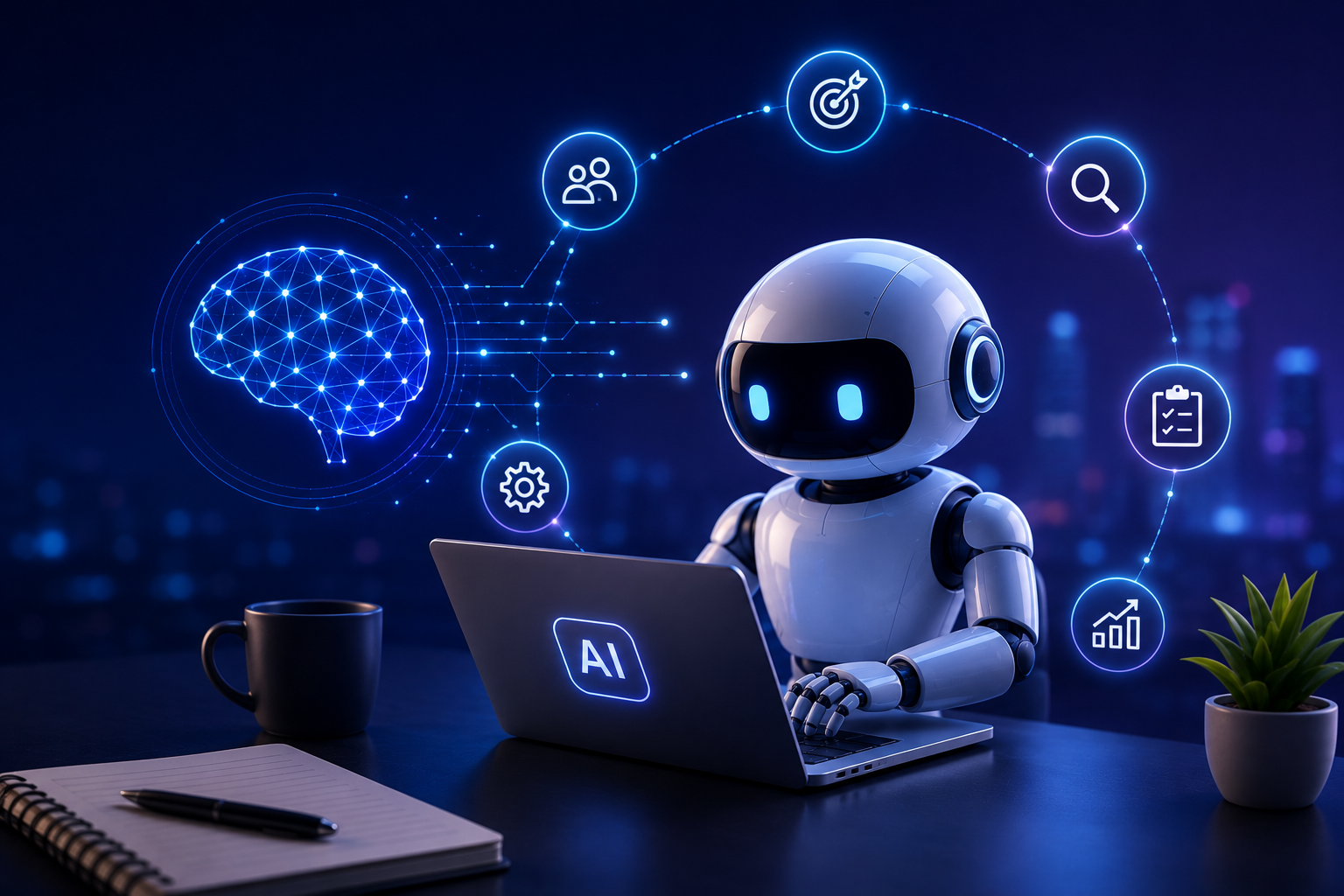
Known as Agentic AI, these intelligent systems are designed not only to respond but also to reason, plan, execute, and achieve goals with minimal human intervention.
Rather than asking an AI to complete one task at a time, businesses can now assign an objective and allow AI agents to determine the steps required to accomplish it.
This marks one of the biggest shifts in enterprise technology since cloud computing.
What Is Agentic AI?
Agentic AI refers to autonomous AI systems capable of making decisions, breaking complex objectives into smaller tasks, using external tools, retrieving information, and completing multi-step workflows independently.
For example, instead of asking an AI:
"Write an email."
You could simply say:
"Prepare a proposal for our new client, gather pricing information, compare competitors, generate a presentation, schedule a meeting, and send me everything for approval."
The AI coordinates every step automatically.
How Businesses Are Using AI Agents
Organizations are rapidly adopting AI agents across multiple departments.
Some practical applications include:
- Customer support automation
- Sales lead qualification
- Financial reporting
- Software development
- Project management
- HR onboarding
- Marketing campaign creation
- Inventory monitoring
- Data analysis
- Internal knowledge management
Instead of replacing employees, these systems eliminate repetitive operational work so teams can focus on strategic decision-making.
Why Developers Should Pay Attention
For software developers, Agentic AI represents an entirely new development paradigm.
Modern applications are no longer limited to static user interfaces.
Developers are now building platforms where AI can:
- Read documentation
- Access APIs
- Execute workflows
- Generate reports
- Create dashboards
- Debug software
- Monitor infrastructure
- Trigger automations
- Coordinate cloud services
This opens opportunities for building smarter SaaS platforms and enterprise software.
The Importance of Human Oversight
Although AI agents are becoming increasingly capable, human supervision remains essential.
Businesses should always establish:
- Approval checkpoints
- Permission controls
- Audit logs
- Security policies
- Error handling
- Human review for critical decisions
Responsible AI implementation balances automation with accountability.
The Competitive Advantage
Companies adopting Agentic AI today are already seeing measurable improvements in productivity.
Benefits include:
- Faster operations
- Lower operational costs
- Reduced manual work
- Improved customer experiences
- Better decision support
- Higher employee efficiency
Organizations that integrate AI agents into their workflows will likely outperform competitors still relying entirely on manual processes.
Looking Ahead
The future of AI is not just about generating answers, it is about achieving outcomes.
Agentic AI is transforming software from passive tools into active digital collaborators capable of solving problems, coordinating tasks, and continuously improving workflows.
For businesses, developers, and entrepreneurs, understanding this technology today will create significant advantages in the years ahead.
The next generation of successful digital products will not simply include AI,they will be built around intelligent agents working alongside people.
Share this article
Copy the article link and send it to anyone who may find it useful.