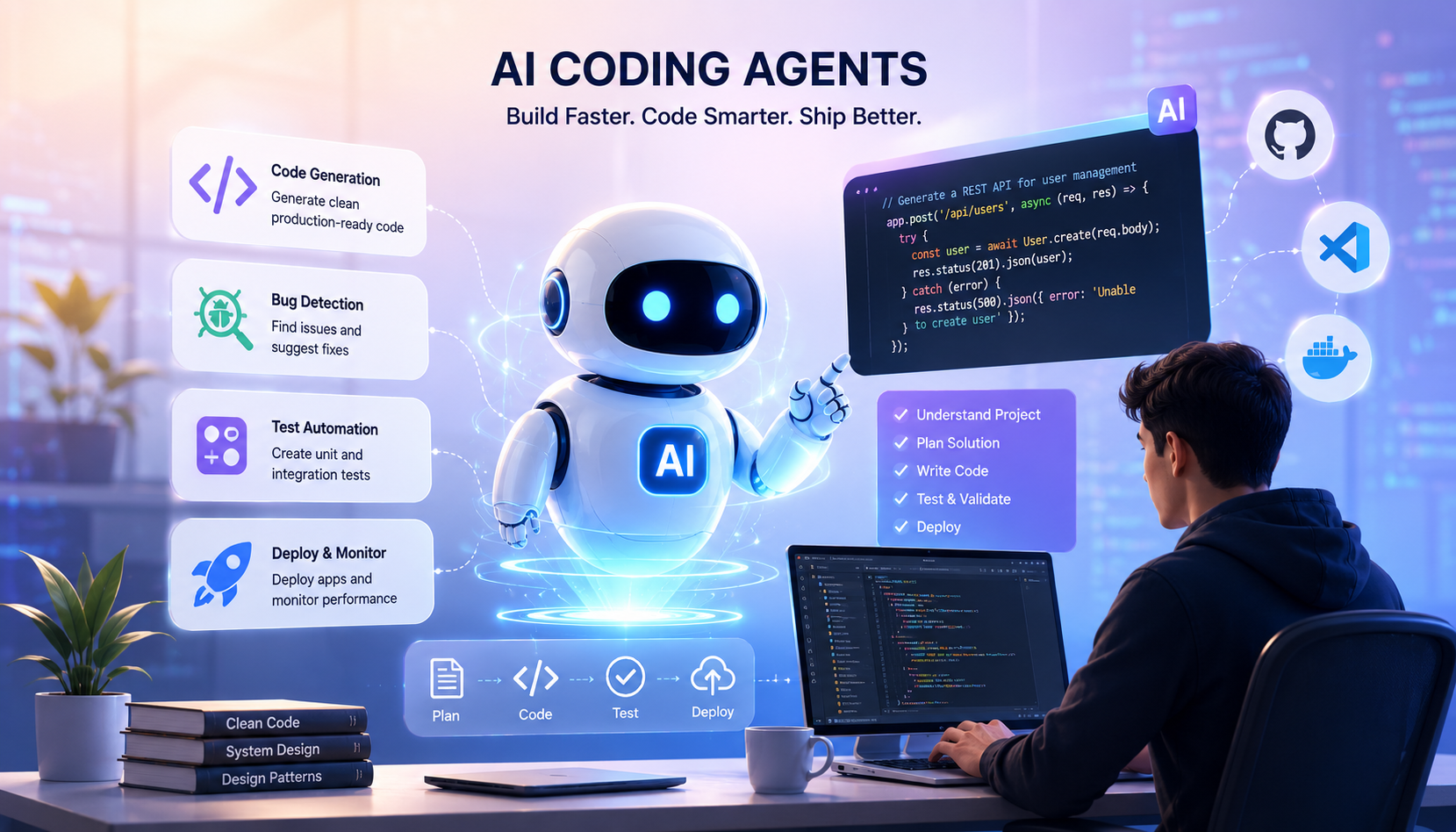
The software development landscape has changed dramatically over the past few years. What started as simple code completion tools has evolved into intelligent AI coding agents capable of understanding entire projects, generating production-ready code, reviewing pull requests, writing tests, fixing bugs, and even helping deploy applications.
In 2026, successful developers are no longer asking whether they should use AIâthey are learning how to collaborate with it effectively.
AI Is Becoming a Development Partner
Unlike traditional autocomplete tools, modern AI agents understand the context of an entire project. They can analyze architecture, detect inconsistencies, recommend best practices, and generate complete features based on natural language instructions.
Instead of spending hours writing repetitive boilerplate code, developers can focus on system design, business logic, security, and user experience while AI handles repetitive implementation tasks.
This collaboration dramatically reduces development time without sacrificing quality.
Productivity Without Losing Control
One of the biggest misconceptions is that AI replaces developers.
In reality, professional developers remain responsible for:
- System architecture
- Security decisions
- Business requirements
- Performance optimization
- Final code review
- User experience
AI simply accelerates the implementation process.
Think of it as having a highly efficient junior developer available 24/7 who never gets tired but still requires guidance and review.
Where AI Coding Agents Save the Most Time
Modern AI assistants excel at repetitive engineering work, including:
- Generating CRUD modules
- Building REST APIs
- Writing database migrations
- Creating validation rules
- Producing unit and feature tests
- Refactoring legacy code
- Writing technical documentation
- Explaining unfamiliar codebases
- Detecting common bugs
- Suggesting performance improvements
These tasks often consume a significant portion of development time, making them ideal candidates for AI assistance.
The New Skill: Writing Better Instructions
As AI becomes more capable, prompting is becoming an essential engineering skill.
Developers who provide clear requirements, define architecture before implementation, and specify coding standards receive dramatically better results than those who rely on vague prompts.
The future belongs to engineers who can communicate effectively with both humans and AI.
Security Still Requires Human Judgment
While AI can generate secure code patterns, developers must still verify:
- Authentication flows
- Authorization rules
- Data validation
- SQL injection protection
- API security
- Encryption practices
- Dependency vulnerabilities
Security should always involve human review before production deployment.
The Competitive Advantage
Companies are beginning to measure engineering efficiency differently. Instead of counting lines of code, teams focus on:
- Faster feature delivery
- Higher software quality
- Better documentation
- Reduced maintenance costs
- Improved developer experience
AI coding agents contribute to all of these areas when used responsibly.
Looking Ahead
The future of software development is not humans versus AI.
It is humans working with AI to build better products faster.
Developers who embrace intelligent tools while continuing to strengthen their engineering fundamentals will remain highly valuable in an increasingly competitive industry.
The best engineers of tomorrow will combine creativity, architecture, communication, and AI collaboration to deliver exceptional digital products.
Share this article
Copy the article link and send it to anyone who may find it useful.