Every growing business eventually encounters the same challenge: information becomes scattered.
Project documentation lives in Google Drive, meeting notes are buried in Slack, client conversations are spread across emails, and technical documentation sits in multiple repositories. As teams expand, finding the right information often becomes more difficult than creating it in the first place.
This is where AI-powered internal knowledge bases are changing the way organizations work.
Instead of manually searching through dozens of folders and applications, employees can simply ask questions in natural language and receive accurate answers within seconds.
The Knowledge Problem
Most companies already have valuable information.
The real problem is accessibility.
Employees waste hours every week searching for:
- Company policies
- Technical documentation
- Previous project details
- Client requirements
- SOPs
- Meeting notes
- API documentation
- Sales proposals
- Design assets
- Internal processes
As businesses scale, this inefficiency grows exponentially.
What Is an AI Knowledge Base?
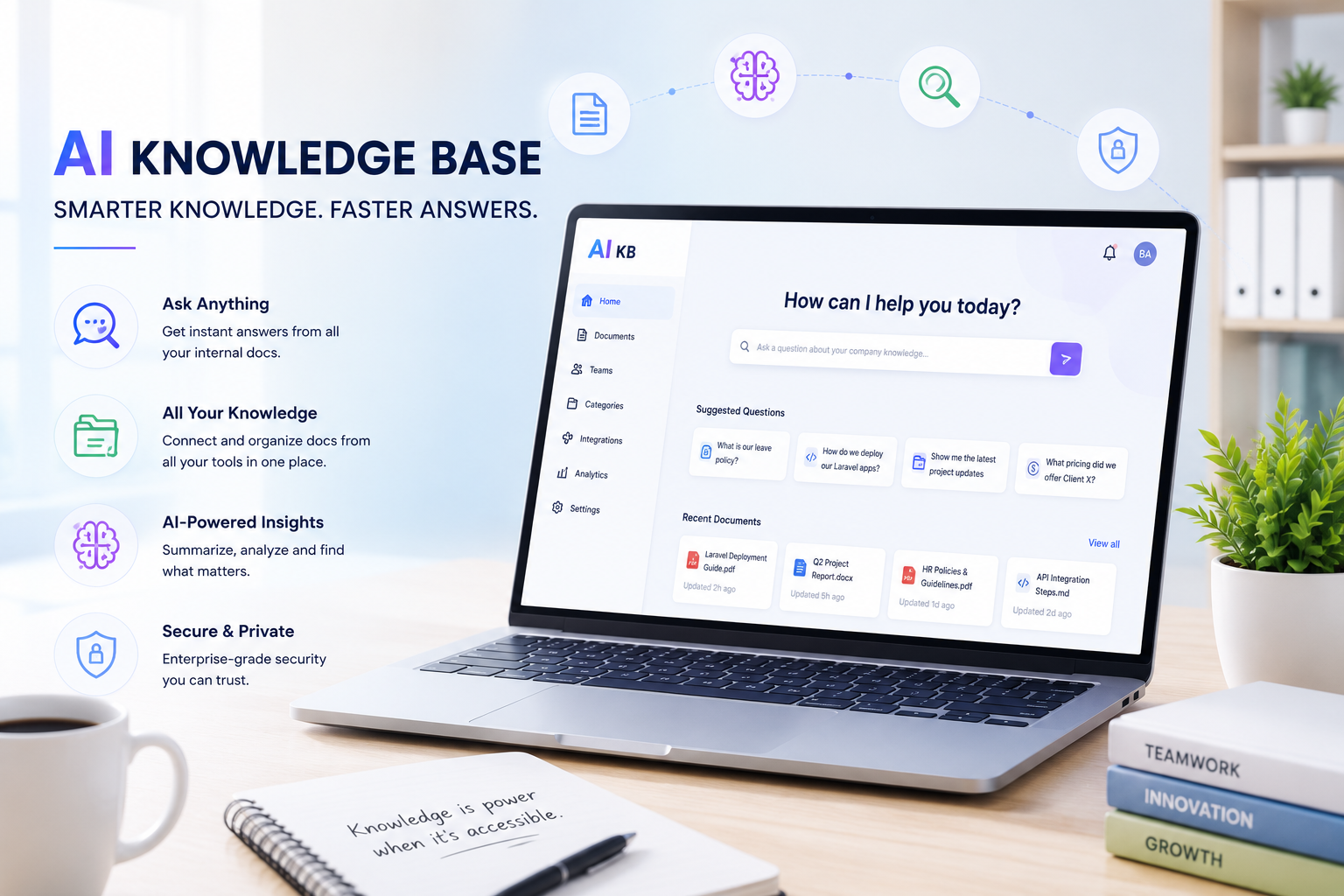
An AI knowledge base combines document storage with artificial intelligence.
Instead of browsing folders manually, users can ask questions such as:
- "Show me our latest Laravel deployment process."
- "What pricing did we offer Client X?"
- "Find our React component guidelines."
- "Summarize the last project meeting."
The AI searches across connected documents, understands context, and delivers concise answers instantly.
Benefits for Modern Businesses
Companies adopting AI knowledge systems experience significant productivity improvements.
Faster Decision Making
Teams no longer spend valuable time searching for documents.
The right information appears immediately, allowing projects to move faster.
Better Team Collaboration
New employees become productive much sooner because they can learn directly from existing documentation.
Instead of repeatedly asking senior developers or managers, they receive instant AI-powered guidance.
Reduced Repetitive Questions
Support teams, HR departments, and technical leads answer the same questions repeatedly.
An AI knowledge base provides consistent responses while reducing interruptions.
Preserving Organizational Knowledge
When experienced employees leave a company, valuable knowledge often leaves with them.
Documenting processes and making them searchable with AI ensures expertise remains available for future teams.
Features Every AI Knowledge Platform Should Include
A modern knowledge system should provide:
- Natural language search
- Document summarization
- Role-based permissions
- Version history
- File previews
- Smart tagging
- OCR for scanned documents
- Integration with Google Drive, Microsoft 365, Slack, and GitHub
- API access
- Activity logs
These capabilities transform static documentation into an intelligent business assistant.
Security Comes First
Internal knowledge often contains confidential information.
Businesses should implement:
- End-to-end encryption
- Multi-factor authentication
- Access control by department
- Audit logs
- Secure cloud backups
- Permission-based AI responses
Security should always be integrated from the beginning rather than added later.
Looking Ahead
AI knowledge bases are quickly becoming an essential part of digital transformation.
As organizations continue generating larger amounts of information, simply storing documents will no longer be enough.
Businesses need systems that understand their data, connect information across departments, and provide intelligent answers in real time.
Companies investing in AI-powered knowledge management today are building faster, smarter, and more collaborative workplaces for the future.
Share this article
Copy the article link and send it to anyone who may find it useful.